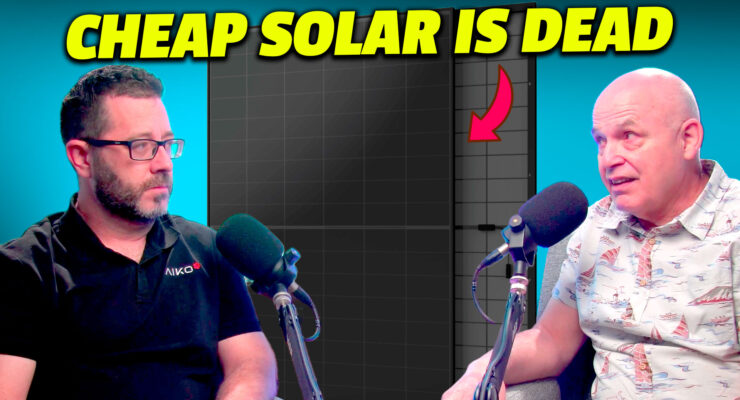
Solar Panels Are About to Get More Expensive — Here’s Why
For more than a decade, solar panel prices have followed one clear direction: down. Installers once dreamed of reaching the “holy grail” of $1 per watt, and today, wholesale prices are well below that milestone. But after years of relentless cost declines, the solar industry may be reaching a turning point.
Behind the scenes, global geopolitics, material shortages, tax changes in China, and currency shifts are converging — and they’re starting to push solar panel prices back up. In a surprising twist, events as distant as Greenland, US currency volatility, and silver markets are now influencing the cost of solar panels in Australia.
So what’s really happening, and what does it mean for homeowners, businesses, and installers?
Have Solar Panel Prices Hit the Bottom?
Historically, solar pricing has collapsed from over $4 per watt to well under $1 per watt, driven by manufacturing scale, technology improvements, and fierce global competition. Today, panels are incredibly cheap by historical standards — but industry data suggests we’re now at an inflection point.
Since late 2024, and more noticeably from January onward, several upward cost pressures have emerged. While panels are still affordable, the era of endless price drops appears to be ending. The big question is no longer “how much cheaper can solar get?” — but “how long will today’s prices last?”
The China VAT Change: A Quiet 9–10% Price Shock
One of the most immediate and measurable impacts comes from China’s export policy.
Until now, Chinese manufacturers received export VAT credits on solar panels, effectively reducing international prices by around 9–10%. That support is being fully withdrawn, with the change expected to flow through global markets from May–June.
What does that mean?
Solar panels exported from China instantly become ~10% more expensive
No technology change, no quality upgrade — just a tax removal
Australian buyers feel the impact with a delay due to shipping cycles
This single policy shift alone is enough to move prices materially higher.

Silver, Glass, and the Rising Cost of Solar Materials
Solar panels may look simple, but they rely on a complex global supply chain — and several key inputs are now getting more expensive.
Silver: The Hidden Cost Driver
Silver is essential for solar cells, particularly in the silver paste used for electrical conductivity.
Silver prices are up ~40% year-on-year
In some panels, silver now represents 20–40% of total panel cost
Investors are using silver as a store of value, pushing prices higher
Glass and Energy Costs
Solar glass manufacturing is energy-intensive and heavily dependent on gas.
Glass producers struggled through 2024 and are now rebuilding margins
Two companies control ~70% of the solar glass market
Rising gas prices are flowing directly into panel costs
These are structural cost increases — not short-term blips.
How US Geopolitics and Greenland Affect Solar Prices
It sounds absurd at first: how could Greenland influence solar panel prices in Australia?
But geopolitics works in unexpected ways.
Currency Flight From the US Dollar
Recent global instability — including US foreign policy tensions — has shaken confidence in the US dollar as a “safe haven”.
As a result:
Capital is flowing out of USD
Investors are moving into other currencies and hard assets
Silver and gold prices rise as stores of value
That silver price rise feeds directly into solar manufacturing costs.
Ironically, while a weaker USD can temporarily strengthen the Australian dollar (helping imports), the material cost increases outweigh the currency benefit over time.

Supply Pressure: It’s Not Just Price — It’s Availability
Another major factor is compressed demand. With manufacturers and distributors racing to get products shipped before tax changes, production capacity is tightening. The issue becomes not just price, but availability.
For installers and commercial buyers, the risk shifts from “Can I buy panels cheaply?” to:
“Can I get panels at all when I need them?”
This is especially relevant as:
Battery installations surge
Commercial hybrid inverters finally hit the market
Larger systems demand more panels per project
Why Solar + Battery Demand Will Keep Rising Anyway
Despite rising panel costs, demand for solar and batteries is accelerating — not slowing.
Why?
Electricity prices in NSW alone jumped ~37%
Grid reliability concerns are increasing
Households want price certainty and energy independence
EVs, air-conditioning, and electrification are doubling household demand
Solar plus battery systems act as a long-term hedge against:
Ironically, the same global instability that pushes panel prices up also pushes more people toward solar.
The Overlooked Detail: Positive vs Negative Power Tolerance
One of the most important — and least understood — solar quality issues is power tolerance.
Some panels are sold with negative tolerance, meaning:
A “470W” panel may legally produce only 460–465W
One weak panel drags down the entire string
Over 10–25 years, lost output adds up significantly
Panels with positive tolerance guarantee:
You get at least what you paid for — often more
Better battery charging performance
Higher lifetime energy yield
For consumers and consultants, checking the datasheet tolerance is one of the simplest ways to avoid hidden losses.

Should Installers and Buyers Act Now?
For many projects, the answer is yes.
Industry modelling suggests:
Panel costs may rise $10,000–$12,000 per container
Importing early can save the equivalent of tens of thousands of dollars
Storage costs are far lower than absorbing price rises later
This doesn’t mean panic buying — but covering supply through to June may protect margins and project viability.
The Big Picture: Why This Matters
Solar panel prices aren’t rising because solar is failing.
They’re rising because:
Global demand is strong
Materials are scarce and valuable
Energy independence is becoming critical
Governments are removing artificial supports
Solar is no longer a fringe technology racing to get cheaper — it’s a core part of the global energy system.
And like all essential infrastructure, its price is now shaped by geopolitics, resources, and long-term value, not just manufacturing scale.