Fast read
Australia is facing a growing volume of end-of-life solar panels as early systems are replaced or upgraded. Solar panel recycling recovers valuable materials like aluminium, glass and copper instead of sending panels to landfill. Panels may be removed due to age, damage, roof works or system upgrades, even if they still function. Recycling involves safe removal, transport, disassembly and material recovery at specialist facilities. Costs and access vary across Australia, but recycling capacity and government programs are expanding. Where possible, reuse or repurposing should be considered before recycling to reduce waste further.
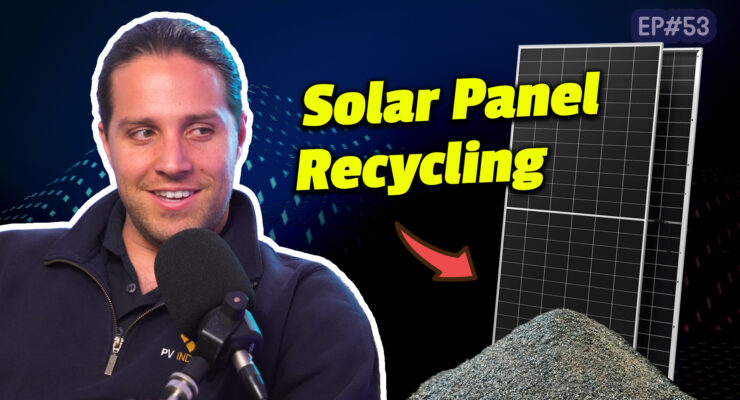
As Australia’s renewable energy landscape matures in 2026, the industry is shifting from simple installation to a sophisticated circular economy. In a recent deep-dive, James Petesic from PV Industries joined Markus to discuss how the sector is tackling a looming wave of waste while unlocking billions in critical minerals.
Mining the Roofs of Australia
James Petesic describes end-of-life solar panels as the “world’s richest silver mine”. With solar manufacturing projected to consume 90% of the global silver supply by 2050, recovering these materials has become a national priority. PV Industries has pioneered technology to recover over 90% of a panel’s weight, processing it into a high-value “solar metal” powder.
Key Materials Recovered:
Aluminum Frames: Recycling aluminum is 90% to 95% more energy-efficient than mining virgin bauxite. Learn more about solar panel materials.
Solar Glass: This glass is being repurposed into sustainable construction materials, including manufactured stone benchtops and road asphalt for major Western Sydney infrastructure.
Silicon & Silver: Specialized mechanical and chemical pathways are being developed with Australian universities to extract critical minerals from ground-down cells.

How Much Does Solar Panel Recycling Cost?
Solar panel recycling is not usually free. Typical costs depend on panel size, location and volume, but generally include:
- A per-panel recycling fee
- Transport and handling costs
- Removal costs if not included in a system upgrade
As recycling infrastructure improves and volumes increase, costs are expected to reduce over time.
Government and Industry Initiatives
Australia is beginning to invest in long-term solar recycling solutions. Key developments include:
- National solar panel recycling pilot programs
- Industry-led stewardship schemes under development
- State-based landfill bans and product stewardship policies
- Collaboration between manufacturers, recyclers and installers
These initiatives aim to create a consistent, nationwide approach to managing solar panels at end of life.
What Homeowners Should Do
If you are replacing or removing solar panels, consider the following steps:
- Confirm whether the panels are truly end of life or could still be reused
- Use a licensed and experienced installer for safe removal
- Ask your installer how panels will be recycled
- Request confirmation or documentation showing panels were recycled responsibly
Older panels may still be functional and suitable for reuse in low-demand applications before recycling.
The Future of Solar Panel Recycling in Australia
Australia’s solar recycling industry is still developing, but momentum is growing.
In the coming years, we are likely to see:
- Improved recovery of silicon and critical minerals
- More local recycling facilities
- Mandatory national stewardship schemes
- Lower recycling costs through scale and standardisation
A well-designed recycling system will ensure solar remains a genuinely sustainable solution from installation through to end of life.
The Impact of the 2026 Battery Surge
The current surge in battery rebates is unexpectedly accelerating solar recycling. Many homeowners are decommissioning 10-to-15-year-old systems early to install higher-efficiency panels that can better support home energy storage systems.
While these panels often still function, James notes that exporting them to developing nations is frequently a “Trojan horse” for waste and is largely illegal under the Basel Convention.