The Geopolitical Chessboard: Why Your Petrol Prices Are Actually About China
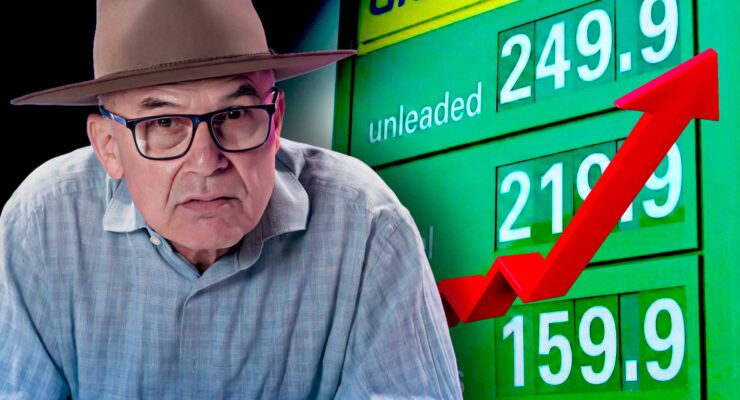
If you nearly dropped your morning coffee seeing a 43-cent jump at the bowser, you aren’t alone. While headlines scream about the Iran conflict and nuclear threats, the reality at the fuel pump is a symptom of a much deeper, more calculated global struggle.
It isn’t just about the Middle East; it’s about a strategic power transition between the United States and China. To understand why we are paying more for fuel today, we have to look at the “Energy Leverage” being applied on the global stage.
The “Nuclear” Red Herring
For months, official reports suggested that Iran’s nuclear capabilities were being successfully neutralised. Yet, suddenly, the narrative has shifted back to a “nuclear crisis.” When a narrative disappears and reappears so conveniently, it often serves as a strategic justification for a different goal.
In this case, the goal appears to be the systematic control of China’s energy supply lines.
Controlling the Flow: A Pattern of Pressure
China is an industrial superpower with a massive Achilles’ heel: Energy Dependency. It imports roughly 11 to 12 million barrels of crude oil every single day. To constrain a rival, you control their costs. Look at the pattern:
Russia: Heavy sanctions have complicated the flow of Siberian crude.
Venezuela: With the recent arrest of President Nicolas Maduro and the US taking a more active role in the Venezuelan oil industry, a massive tap for China is now under Western influence.
Iran: As one of the last major “uncontrolled” suppliers to China, Iran is the final piece of the puzzle.
By dominating the Strait of Hormuz—the narrow choke point through which 20% of global oil passes—the US effectively holds the “off switch” for the Chinese industrial engine.
The Great Paradox: Accelerating the Shift
While the West applies pressure through traditional oil channels, there is a massive, unintended consequence. High oil prices do not just hurt the consumer; they act as a catalyst for change.
In Australia, when petrol hits $2.40 per litre, the cultural debate over Electric Vehicles (EVs) evaporates. It becomes a simple matter of math. People stop asking if they should buy an EV and start asking when.

China’s Strategic Advantage in the 21st Century
While the US spends billions on naval deployments and military operations to control “20th-century energy” (oil), China has spent decades securing “21st-century energy” (electrification).
| Sector | China’s Current Position |
| EV Adoption | Over 50% of new car sales are now electric. |
| Manufacturing | Dominates the global supply chain for solar panels and batteries. |
| Resource Security | Massive stockpiles of coal and increasing domestic oil production. |
| Infrastructure | Light years ahead in grid electrification and charging networks. |
The Cost to the Ordinary Citizen
The irony is palpable. Western strategy to squeeze China via oil prices is causing inflationary ripples that hit ordinary citizens in Australia, Europe, and the US first.
Transport Costs Rise: Petrol prices jump.
Food Prices Follow: Everything moved by a truck becomes more expensive.
Cost of Living Crisis: Inflation leads to higher interest rates and housing stress.
Meanwhile, every time an Australian consumer switches to an EV to escape the petrol pump, they are likely buying a vehicle manufactured in China, supported by a $7.2 billion battery rebate that effectively funnels capital back into the Chinese industrial base.
Summary: A Transition of Power
History shows that power transitions—like those of the Roman Empire or early 20th-century Germany—are rarely quiet. We are witnessing a struggle for the “baton” of global leadership.
The 20th century was defined by who controlled the oil. The 21st century will be defined by who controls the technology that replaces it. Right now, while the West focuses on the fuel of the past, the future is being electrified elsewhere.