Fast read
Finding the cheapest electricity plan in Australia has become increasingly difficult. There are more than 14,000 electricity plan variations nationwide, with different usage rates, supply charges, feed-in tariffs, time-of-use periods and eligibility rules.
Most comparison websites only show plans from selected retailers and may receive commissions when customers switch. Even government comparison tools can recommend plans that are not compatible with a household’s meter type or tariff setup.
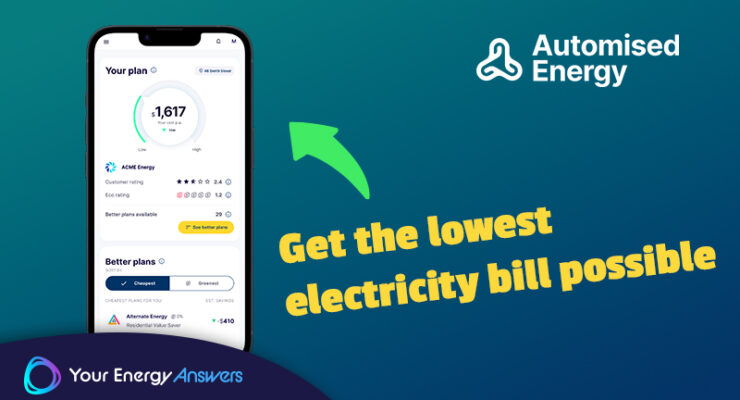
Automised Energy uses a different approach. With the customer’s permission, it securely accesses up to 12 months of actual electricity usage data through the Consumer Data Right framework. It then compares that usage against available plans to identify which one would have produced the lowest bill.
The platform checks plan availability, meter compatibility, eligibility requirements and customer preferences. It does not receive commissions from electricity retailers.
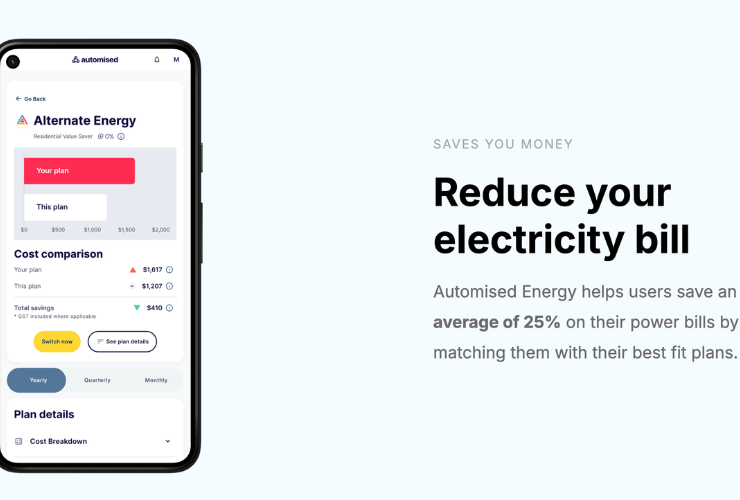
Automised Energy says households can save an average of around 25%, or approximately $400 to $500 per year. Customers can view an initial savings estimate for free. Savings above $250 can be unlocked through a $50 annual subscription.
Need Cheaper Electricity? Find the Lowest Power Plan for Your Home in 2026
If you’ve typed “how do I get cheaper electricity” or “find me a cheaper electricity plan” into Google lately, you’re not alone. Cost-of-living pressure has pushed millions of Australians to go looking for a lower power bill — and most of them hit the same wall: there are simply too many plans to compare by hand. At last count accoss Australia there are a staggering 14,000 plus electricity plans – madness.
This guide breaks down why finding the lowest electricity plan has become so hard, what actually works to cut your bill, and how a new category of independent, data-driven services is making the whole process automatic.
Why your electricity bill keeps going up
Electricity pricing in Australia isn’t set by one flat rate anymore. Retailers layer in time-of-use tariffs, demand tariffs, controlled-load rates, solar feed-in tariffs, and daily supply charges — and every retailer configures them differently. Now with the three hours of free power – the whole power pricing has become even more confusing.
Depending on your postcode, meter type, and whether you have solar or a controlled load, there can be anywhere from roughly 150 to over 600 individual plan variants available at a single address, spread across around 20 retailers in states like New South Wales and Victoria.
That complexity is exactly why so many households end up overpaying. Nobody has time to manually replay a year of half-hourly usage data across hundreds of plans to see which one actually works out cheapest for their specific habits.
The problem with “compare the market” style sites
Most electricity comparison websites only show plans from a limited panel of retailers, and many are paid a referral fee by the retailer you sign up with — which is a built-in conflict of interest. Government-run comparison tools like Energy Made Easy are independent and scan the whole market, but they typically only check plan availability at your address. They generally don’t check whether a plan is actually compatible with your specific meter type, which means the “best” result they show you might not even be something you can sign up to.
Enter automated, data-driven plan matching
A newer approach — pioneered in Australia by Automised Energy — flips the process on its head. Instead of you trying to estimate your usage and guess which plan suits you, the platform securely pulls your actual electricity data straight from your retailer using the government’s Consumer Data Right (CDR) framework, the same legislation that underpins open banking.
Once it has your last 12 months of usage in 30-minute intervals, it replays that real usage data against every available plan — reportedly around 14,000 plus plans nationally, refreshed nightly — to work out which one would have produced the lowest bill for your household specifically.
According to the platform’s founder, Matt Peterson, most households can save on average around 25% on their power bill, which works out to roughly $400 to 500 a year, and with about nine million electricity connections across the country, that adds up to an estimated $4.5 billion a year that Australians could be overpaying collectively. Larger households and small businesses on higher usage have reportedly seen far bigger annual savings.
Because it works directly off CDR data, there’s no need to install any monitoring hardware, dongles, or clips — you simply grant permission and the platform does the comparison for you.
What makes this different from a basic comparison site
A genuine plan-matching service goes through several layers most comparison tools skip:
- Availability — is a better plan actually offered at your address?
- Compatibility — does that “better plan” match your specific meter type (smart meter vs. legacy meter, controlled load, solar export)?
- Eligibility — some plans are restricted to specific memberships, age groups, or ownership of solar/EVs, and are otherwise buried in the fine print.
- Suitability — your own preferences, such as wanting a 100%-green retailer or an Australian-owned provider, even if it isn’t the absolute cheapest option.
Skipping the compatibility check is a common failure point of free government tools — you can be shown a great-looking plan on paper, then get rejected when you actually try to switch because your meter doesn’t support it.
Independence matters more than people realise
One detail worth checking before you trust any energy comparison result: who pays for the service? Many comparison sites earn commissions from retailers, which quietly shapes which plans get recommended. Automised Energy has structured itself to take no commission from any retailer, so its recommendations aren’t influenced by referral payments — the model is built around helping the consumer save, not around retailer partnerships.
How the switching process works
Once a better-fit plan is identified, the typical flow looks like this:
- Securely link your electricity account via the Consumer Data Right.
- The service replays your actual historical usage against every available plan for your address, meter type, and network.
- You’re shown how much you could save — smaller savings are shown for free, while larger savings (generally anything over $250 a year) require a low-cost $50 annual subscription to unlock full plan details and a pre-filled switch request. So you will pay $50 to save over $250 – which sounds like a fair deal.
- If you switch, ongoing monitoring via Automised Energy can flag it again automatically if your new retailer raises rates or a better plan appears later — as long as you keep permission linked to your current provider.
Renters can use this too
A common misconception is that money-saving energy tools are only useful to homeowners with solar and batteries. In reality, plan-matching services work off your electricity account and meter, not who owns the property — so renters get exactly the same access to lower-priced plans as homeowners do, with zero infrastructure required.
Time-of-use tariffs aren’t always the enemy
Many people assume flat-rate plans are automatically cheaper than time-of-use tariffs, since time-of-use pricing punishes peak-hour usage — typically the after-work, dinner-and-bath-time window for families. In practice, data-driven analysis often shows the opposite: because time-of-use plans discount many other hours of the day, a large share of households come out ahead on a time-of-use tariff overall, even without a battery. The only way to know for sure is for Automised Energy on the backend to compare actual usage pattern against various tariffs. Much better than guessing.
Bottom line: stop guessing, start comparing with real data
If you’re searching for ways to lower your electricity bill, the fastest, most reliable path isn’t another spreadsheet or a comparison site that only shows a handful of retailers — it’s a service that pulls your real usage data and checks it against every available plan, including whether you can actually switch to it.
You can check your own potential savings directly at automised.energy — sign-up takes a few minutes, and the initial savings estimate is free to view before you decide whether to unlock full plan details.
Further reading
- Automised Energy — official site
- Automised Energy pricing model
- pv magazine Australia: Automised Energy launches CDR-powered comparison app
Disclosure: Your Energy Group is working with Automised Energy to bring lower bills to electricity using households of Australia.