A Solar Installer’s View from the Front Line
Australia’s battery market has changed faster than almost anyone expected.
Only a few years ago, most homeowners were still focused on installing solar panels. Today, many solar retailers report that batteries have become the main enquiry, driven by rising electricity prices, falling battery costs, and government incentives.
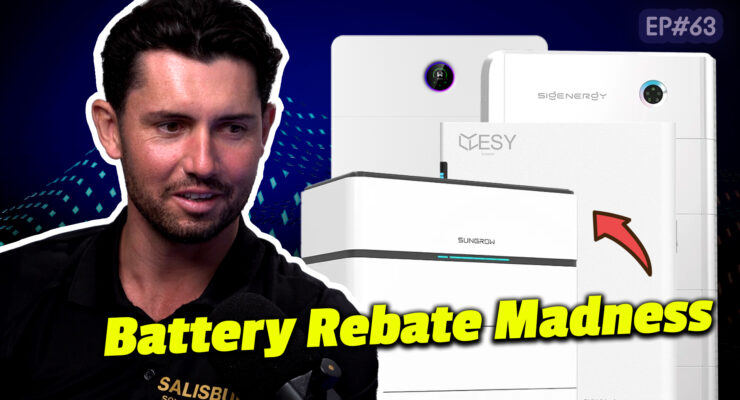
For Hugh Salisbury, owner of Salisbury Solar & Electrical in Northern NSW, the shift has been dramatic.
Working across the Tweed, Byron Bay and Northern Rivers region, Hugh has watched the market transform from predominantly solar installations to a landscape where batteries are now dominating customer conversations.
But according to Hugh, the battery boom is creating both opportunities and problems.

From Solar Boom to Battery Boom
Before battery rebates and falling battery prices, solar systems were the main product homeowners wanted.
According to Hugh, solar-only installations once outnumbered battery jobs by almost ten to one.
Today, that situation has completely reversed.
Many homeowners already have solar systems installed, but they’re now looking for ways to store excess energy and reduce their reliance on increasingly expensive grid electricity.
As feed-in tariffs have fallen across Australia, batteries have become a logical next step for many households.
Rather than exporting solar energy for a few cents per kilowatt-hour, homeowners can store it and use it during the evening when electricity prices are highest.
The Biggest Mistake Homeowners Are Making
One of the biggest concerns Hugh sees is homeowners being sold battery systems that simply don’t match their solar generation.
The temptation is understandable.
A larger battery sounds better on paper.
Many sales pitches focus on battery size alone, encouraging customers to install huge storage systems without considering whether their existing solar system can actually charge them.
The problem?
A battery is only as effective as the solar system feeding it.
If a homeowner installs a very large battery but only has a small solar array, they may struggle to fully charge the battery on a regular basis.
This can reduce the financial benefits and potentially affect long-term battery performance.
According to Hugh, proper system sizing remains one of the most important parts of any battery installation.
Why Good Advice Matters
The battery boom has also attracted a wave of opportunistic sales companies.
Hugh says many regional communities continue to see businesses arrive, sell systems aggressively, then disappear once the installation is complete.
This often leaves local installers cleaning up the mess.
In many cases, the problems include:
- Poorly sized solar systems
- Oversized or undersized batteries
- Inferior installation quality
- Lack of after-sales support
- Unrealistic savings expectations
For homeowners, the result can be frustration and costly upgrades later.
For reputable installers, it creates additional work fixing problems that should never have occurred in the first place.
Looking Beyond Today’s Electricity Bill
One of the strongest themes from Hugh’s approach is planning for the future rather than just current energy usage.
Many homeowners only look at their existing electricity bill when deciding on a solar or battery system.
However, household electricity consumption is changing rapidly.
Future energy demands may include:
- Electric vehicles
- Heat pump hot water systems
- Ducted air conditioning
- Pool heating
- Home electrification upgrades
A solar system that appears adequate today may become undersized within just a few years.
That’s why many installers now recommend maximising available roof space where possible and designing systems with future growth in mind.
The Electrification Opportunity
The battery conversation often opens the door to broader discussions about home electrification.
Rather than focusing solely on batteries, Hugh says homeowners should consider how every major appliance in the home uses energy.
Simple changes can often deliver immediate savings.
For example, moving electric hot water systems onto solar generation during the day can significantly reduce grid consumption.
Many homeowners continue paying off-peak tariffs without realising that daytime solar generation could be doing much of the work instead.
When solar, batteries, hot water, EV charging and air conditioning are considered together, the financial outcomes can be substantially better.
Which Battery Brands Are Leading?
With dozens of battery brands now entering the Australian market, choosing the right product can be difficult.
Hugh highlights three battery systems that currently feature heavily in his business:
- Sigenergy
- ESY SunHome
- Sungrow
Each serves a different segment of the market.
Budget-conscious households often look for value-oriented solutions, while others prioritise advanced features, backup capability, system integration and future expandability.
The rapid pace of innovation means battery technology is evolving quickly, making installer support and manufacturer backing increasingly important considerations.
Solar Still Matters
One misconception emerging during the battery boom is that batteries are more important than solar panels.
In reality, the two work together.
A battery without adequate solar generation has limited value.
According to Hugh, many existing solar systems installed 10 or more years ago were designed for a completely different energy landscape.
Older systems may have been suitable when feed-in tariffs were generous.
Today’s environment is different.
For many homes, upgrading solar capacity alongside a battery installation may provide a better long-term outcome than adding storage alone.
Reputation Still Wins
Operating in a regional community means reputation remains everything.
Word-of-mouth referrals continue to drive a significant portion of business for local installers.
According to Hugh, the greatest satisfaction comes when customers return months later reporting dramatically reduced power bills and recommending the business to family and friends.
While battery rebates, electricity prices and new technology dominate headlines, the fundamentals haven’t changed.
Good advice.
Quality installation.
Proper system design.
And long-term customer support.
These are still the factors that determine whether a solar and battery investment succeeds.
The Bottom Line
Australia’s battery boom is creating enormous opportunities for homeowners to reduce electricity costs and improve energy independence.
However, not all battery systems are created equal.
The best outcomes come from carefully matching solar generation, battery storage and future household needs.
For homeowners considering batteries, the lesson is simple:
Don’t just buy the biggest battery.
Build the right energy system for your home, your lifestyle and the future you’re planning for.