Fast read
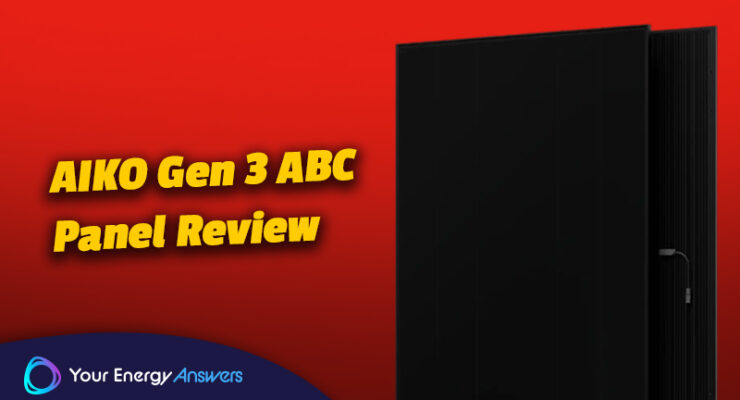
AIKO has officially introduced its third-generation ABC (All Back Contact) 60-cell solar module to the Australian market, bringing higher efficiency, improved durability and enhanced performance for residential solar systems. While many premium solar panels now use N-Type TOPCon technology, AIKO continues to differentiate itself with ABC technology, which places all electrical contacts on the back of the solar cell to capture more sunlight. The result is one of the highest-efficiency residential solar panels currently available. For homeowners with limited roof space, or those planning to install a battery or electric vehicle, the Gen 3 module offers an opportunity to generate more electricity from the same roof area while preparing for Australia's increasingly electrified future.
Solar panel technology continues to evolve, but meaningful improvements don’t happen every year. Most new product launches focus on slightly higher power ratings or small manufacturing refinements rather than major leaps in performance. AIKO’s latest release, however, is attracting serious attention because it builds on one of the most advanced residential solar technologies currently available.
The launch of the Gen 3 ABC 60-cell and 54-cell solar modules in Australia represents a massive step forward for AIKO’s All Back Contact (ABC) technology. Rather than following the same development path as many other manufacturers, AIKO has continued refining a design philosophy centred on one goal: generating as much electricity as possible from every square metre of roof space.
For Australian homeowners, that could become increasingly important. Electricity usage is rising as more households install batteries, purchase electric vehicles, and replace gas appliances with electric alternatives. At the same time, roof space remains one of the biggest limitations when designing a solar system. If your roof can only accommodate a certain number of panels, choosing panels that generate more electricity can significantly improve the long-term value of your investment.
What’s New With the Gen 3 ABC Module?
The third-generation ABC module isn’t just a cosmetic update; it represents a major engineering leap. The flagship Gen 3 60-cell module delivers an industry-shattering peak power output of up to 545W, while the residential-standard 54-cell format (the NeoStar 3 series) scales up to 500W.
Crucially, AIKO has crossed a long-sought industry benchmark by pushing module conversion efficiency past 25% in mass production (up to 25.2% for top-tier variants). To put this into perspective, standard residential panels currently sit between 21% and 22% efficiency.
This performance density relies on three core technical innovations:
- Zero-Gap Cell Layout: Eliminates the wasted space between cells, maximizing the active surface area exposed to the sun.
- Invisi-Ribbon Interconnection: Completely hides structural ribbon elements beneath the cells to ensure a completely unshaded front face.
- Silver-Free Copper Metallisation: Unlike conventional cells that use printed silver paste, AIKO uses copper interconnects. This increases cell bending strength by roughly 20%, drastically reducing the risk of micro-cracks over the panel’s lifespan.
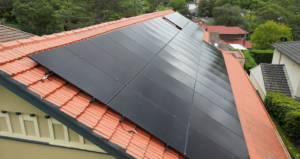
Technical Specifications: AIKO Gen 3 ABC vs. Premium TOPCon
To see how AIKO’s Gen 3 stacks up against standard premium N-Type TOPCon panels on the market, look at the core data:
| Specification | AIKO Gen 3 ABC (60-Cell Variant) | Typical Premium TOPCon |
| Max Power Output | Up to 545W (500W for standard 54-cell format) | ~440W – 460W (standard format) |
| Module Efficiency | >25.0% (Up to 25.2%) | ~22.0% – 23.0% |
| Temperature Coefficient ($P_{max}$) | -0.26%/°C | -0.29%/°C to -0.30%/°C |
| Year 1 Degradation | 1.0% | ~1.5% – 2.0% |
| Annual Degradation (Yrs 2–30) | 0.35%/year | ~0.40% – 0.55%/year |
| Output Guarantee (Year 25) | 90.6% | ~87.0% – 89.0% |
| Output Guarantee (Year 30) | 88.85% | ~83.0% – 86.0% |
| Shade Tolerance | Cell-level optimization (+30% output in partial shade) | Standard bypass diode restriction |
Why AIKO Continues to Focus on ABC Technology
Most premium solar panel manufacturers have adopted N-Type TOPCon technology because it offers higher efficiency and lower degradation than older P-Type solar cells. TOPCon has become the baseline for premium residential solar panels. AIKO, however, has chosen a radically different direction.
By relocating 100% of the electrical contacts to the back of each solar cell, AIKO reduces the grid-line shading losses to absolute zero. This allows the ultra-high resistivity N-type silicon wafers to capture every available photon.
Furthermore, AIKO has introduced cell-level partial shading optimization. In standard panels, shading a single cell can shut down an entire third of the panel via a bypass diode. TUV Nord testing has confirmed that AIKO’s Gen 3 ABC panels generate up to 30% more power in real-world, partially shaded conditions because intelligent internal routing allows unshaded parts of the cell layer to continue working independently.
Why This Matters for Australian Homes (The Heat Factor)
Australian homes are consuming more electricity than ever before. Reverse-cycle air conditioning, electric hot water systems, induction cooktops, home batteries, and electric vehicles are all driving up household energy demand.
But high raw wattage is only useful if a panel can handle the Australian climate. Solar panels are tested in labs at 25°C, but a dark rooftop in Adelaide, Brisbane, or Perth can easily soar past 65°C in summer. As panels heat up, their power output drops.
This is where AIKO’s temperature coefficient of -0.26%/°C shines. Because it loses less efficiency per degree of temperature rise than standard TOPCon panels (-0.29%/°C), the Gen 3 ABC panel retains more of its nameplate capacity when you need it most—on scorching summer afternoons when the air conditioning is running at full blast.
Who Is the Gen 3 ABC Panel Best Suited For?
The Gen 3 ABC module is explicitly positioned as a high-density performance product, meaning it carries a price premium over entry-level options.
The latest AIKO panel is particularly attractive if you:
- Have a small, complex, or heavily angled roof: You can achieve a 6.6kW or 10kW system capacity using significantly fewer panels, leaving room to navigate skylights, valleys, or vents.
- Deal with moving shade: If trees, antennas, or neighboring structures cast partial shadows during the day, the panel’s advanced shade optimization minimizes system drops.
- Are future-proofing for EVs and batteries: Pushing more raw kilowatts out of a compact footprint means faster daytime battery charging and more surplus power to offset grid prices.
- Value premium longevity: The physical build is highly durable. The dual-glass variant (like the NeoStar 3S+) features 2.0mm tempered glass on both sides, yielding an IEC Class A fire rating and a 35mm hail impact certification.
Looking Beyond the Wattage: Warranties and Lifespan
One mistake many homeowners make when comparing solar panels is focusing only on the wattage printed on the specification sheet. Long-term degradation determines the actual return on investment.
AIKO backs its Gen 3 residential lineup with a 25 to 30-year product warranty (30 years for the dual-glass 3S+ models) and a 30-year linear performance warranty. Thanks to N-type silicon’s natural resistance to Light-Induced Degradation (LID), the panels are guaranteed to retain 90.6% of their original power output at Year 25, dropping to no less than 88.85% by Year 30.
Final Thoughts
The launch of AIKO’s Gen 3 ABC solar module demonstrates that solar panel technology still has room for disruptive leaps. Rather than chasing marginal improvements, AIKO’s over-25% mass-production efficiency, -0.26%/°C temperature coefficient, and advanced shade resilience offer a genuine point of difference in a crowded market.
Ultimately, if your roof space is unlimited and completely shade-free, standard TOPCon panels will offer a highly cost-effective option. However, for Australian homeowners facing space constraints, high thermal exposure, or a highly electrified future, AIKO’s Gen 3 ABC technology represents one of the most technically accomplished, robust ways to future-proof a home solar investment.