Australia’s Battery Rebate Isn’t Over Yet — Here’s What Happens Next
Australia’s home battery rebate has reached a critical moment. Not because it failed, but because it worked faster — and harder — than anyone expected. What began as a targeted energy policy has now become a budget-level issue, sitting squarely with Treasury and the Expenditure Review Committee rather than the energy portfolio.
That shift matters, because once a program lands in Treasury territory, the rules change. Decisions are no longer driven by long-term system optimisation or industry development. They are driven by cost containment, speed, and political risk. And right now, all three are flashing red.
From the outset, the Cheaper Home Batteries program was never intended to remain static. The rebate was designed to taper gradually over time, falling from around $372 per kilowatt-hour in the early years (after admin costs) to closer to $188 per kilowatt-hour by 2030. Even at the end of the decade, households installing a 20 kilowatt-hour battery would still have received more than $3,500 in support.
That glide path assumed something important: a controlled, predictable rate of uptake and relatively modest system sizes.
Neither of those assumptions has held. Over the first months of the scheme, the average battery size has expanded rapidly. What began at roughly 16 kilowatt-hours has moved closer to 28 kilowatt-hours, and in many cases far beyond that. With rebate values sitting around $350 to $400 per kilowatt-hour, this has pushed the effective subsidy per installation well beyond $10,000.
The financial consequences have been dramatic. In November alone, around 36,000 batteries were installed — roughly 2,000 per day — burning through an estimated $350 to $360 million in rebate funding in a single month. Official figures suggest between $850 and $900 million has already been paid. But once pre-sales and deposits already taken by installers are factored in, the real committed spend is likely well just shy of $2 billion.
At current rates, that leaves perhaps $300 to $500 million uncommitted. In other words, the remaining budget is measured in weeks, not years.
This is why the debate has shifted so sharply. The question is no longer whether the rebate should change, but how abruptly those changes will be made.
The Smart Energy Council, representing much of the industry, has argued strongly against a blunt, guillotine-style cutoff. History shows what that looks like: sudden announcements, panic installations, stranded inventory, broken contracts, and businesses left carrying losses they cannot absorb. Wholesalers are particularly exposed, with long supply chains, imported stock already on the water, and payment terms locked in months in advance.
Instead, the Council has proposed a tiered rebate structure — an imperfect but pragmatic compromise.
Under this model, smaller battery systems would continue to receive the full rebate, while progressively larger systems would attract a reduced level of support. The aim is not to ban large batteries outright, but to slow the burn rate and rebalance incentives so the scheme benefits more households over time rather than concentrating value among a smaller group maximising rebate size.
It is not a perfect solution. But it is a workable one. The problem is that workable solutions are not always the ones Treasury chooses.
This decision now sits with the Expenditure Review Committee — a small group made up of the Prime Minister, Treasurer, and a handful of senior ministers including Minister Bowen. Their job is not to optimise energy systems. Their job is to protect the budget.
Context matters here. The government has already walked away from a $300 energy bill rebate that would have helped eight to nine million households. If a measure that broad could not survive the fiscal environment, a battery rebate burning hundreds of millions of dollars a month is deeply exposed. From Treasury’s perspective, a slow taper carries risk. Any transition period may simply trigger a rush of installations, accelerating the burn rather than slowing it. A three-month taper at current settings could open a $700 million to $1 billion hole in the budget — a figure Treasury will not tolerate.
That leaves three realistic outcomes.
The best case is managed reform: advance notice, a tiered rebate, and tighter eligibility rules that preserve long-term grid benefits while controlling costs. This aligns with Australia’s Integrated System Plan and avoids unnecessary damage to the industry. But it requires restraint, coordination, and political courage — qualities not always abundant under fiscal pressure.
The most likely outcome is a hard reset with short notice. Rebate values are cut sharply, eligibility tightened, and the transition window measured in weeks rather than months. This would be disruptive, but defensible from a budget standpoint.
The worst-case scenario remains an abrupt cutoff. The rebate is paused or closed with little warning, instantly capping exposure but inflicting severe damage across the supply chain. While not preferred, this option becomes more likely the longer Treasury believes control has already been lost.
All of this sits against a larger truth that the 2026 Draft Integrated System Plan makes impossible to ignore.
Transmission costs have almost doubled. AEMO now warns that delays and cost overruns could increase system costs by up to 30 percent. At the same time, coal generation is becoming increasingly unreliable, while gas remains volatile and expensive. In that environment, distributed household batteries are no longer a nice-to-have. They are core infrastructure.
The ISP projects home battery capacity rising from 20 gigawatts to 27 gigawatts by 2050. It also projects households providing more than a third of total capacity in the National Electricity Market. In plain terms, households are becoming the power stations.
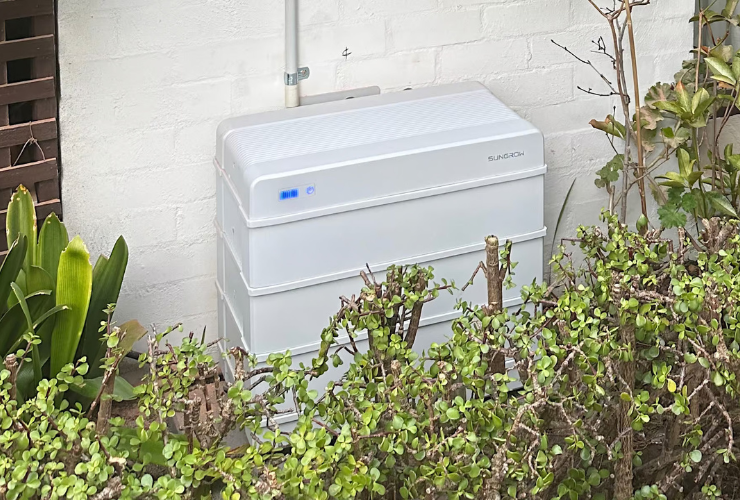
That future only works if battery uptake continues.
Remove the rebate entirely and battery adoption slows. Transmission costs rise. Gas reliance increases. Price volatility worsens. Electricity bills go up — not down. Every dollar spent supporting batteries today avoids several dollars of future system cost.
That is the real tragedy of this moment. The rebate is essential, but its current structure is unsustainable. Reform is necessary. Panic is not.
After six months of real-world data, the path forward is clear. The rebate must come down. Oversizing must be discouraged. A tiered structure offers the least damaging adjustment. But Treasury logic is blunt. Speed will matter more than elegance, and certainty more than fairness.
- The window for a smooth landing is closing rapidly.
- The next decision will not be perfect. It will be fast.
And whatever happens next will shape Australia’s energy system — and electricity prices — for decades to come.