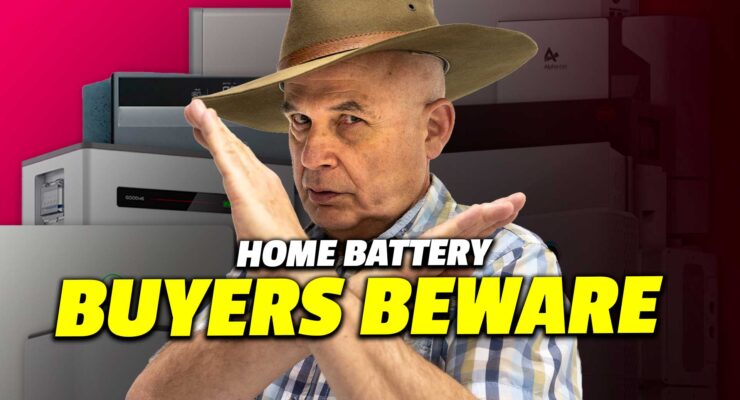
Not all battery warranties are the same – Buyer Beware
Buying a home battery is a major investment. Whether you spend $5,000, $8,000 or well over $10,000, you are usually expecting a product that will quietly work in the background for a decade or more.
What most buyers don’t realise, however, is that two batteries with the same capacity, similar specs, and even the same rebate attached can have very different warranty protection behind them.
The difference doesn’t come down to marketing claims or warranty length on paper. It comes down to how that battery entered Australia, and who is legally responsible when something goes wrong.
This is where many homeowners get caught out.
Why battery warranties are more complex than they look
On the quote sheet, most batteries look similar: 10-year warranty, a performance guarantee, and some reassuring language about support. What’s often missing is the most important detail of all:
Who actually stands behind that warranty if the battery fails?
Under Australian Consumer Law, the party that imports a product into Australia takes on significant legal responsibility. That single fact creates three very different warranty scenarios in the battery market today.
The Gold Standard of battery warranty: Three layers of protection
The safest way to buy a battery is through a structure that provides three layers of warranty protection:
- The manufacturer
- The distributor
- The solar retailer / installer
In this model, the manufacturer produces the battery and brings it intro Australia, an Australian distributor takes over the distribution and supplies it, and a local installer sells and installs it in your home.
Why does this matter?
Because if the overseas manufacturer disappears, changes strategy, or stops supporting that product, the distributor becomes legally responsible under Australian Consumer Law. And if the distributor were to fail, the installer is still on the hook to support the customer.
This structure creates what is best described as three parachutes. If one fails, there is another layer beneath it.
Distributors also act as a quality filter. They cannot afford to import unreliable products because they carry real legal and financial exposure. That’s why reputable distributors typically limit their range and focus on products with strong track records, proper testing, and local support infrastructure.
The Middle Ground in battery warranty: Two layers of protection
The second scenario sits somewhere in the middle.
Here, a solar installer buys directly from a manufacturer that has an Australian presence, but without a local distributor acting as the importer of record.
In this case, the two layers of protection are:
- The manufacturer
- The installer
If the manufacturer remains active in Australia and continues to honour warranties, this can work reasonably well. But if the manufacturer withdraws from the market, restructures, or fails altogether, the installer becomes the primary point of responsibility.
That leaves you with two parachutes instead of three. It’s not automatically unsafe, but it carries more risk—especially in a market known for boom-and-bust cycles.
The Danger Zone: One (or Zero) layers of batter warranty protection
The highest-risk scenario is when a solar installer imports batteries directly from overseas, often as generic products with private branding.
In this case, Australian Consumer Law treats the installer as the manufacturer.
That means:
- If the battery has a defect, recall, or widespread failure, the installer must pay
- If the installer lacks the financial capacity to replace the many failed units, customers are left exposed
- If the solar retailer business closes or “phoenixes,” the warranty becomes meaningless
This is effectively one parachute – or none at all.
No matter how attractive the price looks, the risk is substantial. A small installer is unlikely to have millions of dollars set aside to manage large-scale warranty claims. When things go wrong, homeowners are often left with no practical recourse.

Why can make this risk worse?
Government battery rebates can unintentionally amplify this problem.
When prices are subsidised, cheap batteries become even more tempting. But unlike solar rebates, battery rebates can generally only be claimed once. If a low-cost battery fails outside effective warranty support, you don’t get a second chance.
That means a poor buying decision today can force you to pay full price for a replacement later.
Three questions every buyer should ask
You don’t need to be an expert to protect yourself. Before signing a quote, ask these three simple questions:
- Does the manufacturer have a genuine Australian presence and support operation?
- Who imported the battery into Australia – a reputable distributor or the installer themselves?
- How long has the installer been operating, and will they realistically be around in 10 years?
If all three answers stack up, you are far more likely to have a battery system that remains supported long after installation. If not, look for a more reliable deal, even if you have to spend a little more money.
The Bottom Line
Not all battery warranties are created equal. Two systems with the same rebate and similar pricing can carry dramatically different levels of risk depending on how they entered the country and who stands behind them.
When it comes to batteries, the cheapest option on the quote sheet can easily become the most expensive mistake you make.
Buy with your eyes open, understand the warranty structure, and make sure your investment comes with real protection—not just promises.