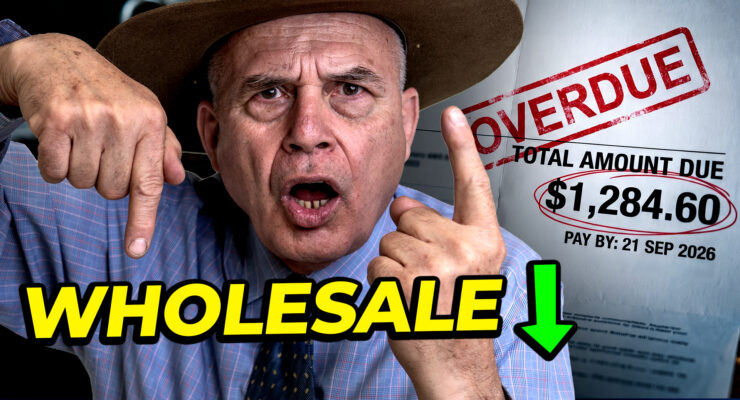
Wholesale Electricity Prices Have Halved in Australia. So Why Is Your Bill Still Going Up?
Short answer: Wholesale electricity prices in Australia have fallen from their 2022 peak to around $100 per megawatt hour. Your bill hasn’t followed because you don’t buy wholesale power. You pay a retail price that includes network costs, supply charges and retailer margins. Meanwhile, those low wholesale prices are making it hard to fund new generation and storage, and they are squeezing smaller retailers out of the market.
Key takeaways
- Wholesale prices peaked at roughly $180 to $220 per MWh in 2022 and are now around $100 per MWh. Forecasts point to $80 to $90 by 2030.
- Your bill reflects more than wholesale cost, including network charges, daily supply charges and retail margins.
- CSIRO’s chief economist has indicated that prices need to rise above $100 after 2030 to justify building replacement capacity.
- Zen Energy Retail entered voluntary administration on 3 July 2026, and its customers moved automatically to AGL.
- Fewer retailers can mean less competition, which makes switching plans one of the few levers households control.
Why have wholesale prices fallen so much?
Australia has more rooftop solar per person than anywhere else in the world, with over 4.4 million systems installed. That flood of solar pushes wholesale prices down during the day, and grid-scale batteries and new renewables have added to the effect.
In 2022, wholesale prices hit their most expensive year on record. Today they have more than halved. On paper, that is good news.
Why is my electricity bill still going up?
Because there are two different prices.
- The wholesale price is what generators are paid in the market.
- The retail price is what you see on your bill.
Between those two sits a long chain of costs: poles and wires, daily supply charges, metering, retailer operating costs and profit. A fall in the wholesale price can be offset by increases elsewhere, and in many households’ July and August bills, supply charges have risen.
So when a minister says wholesale prices are falling and your bill says otherwise, both statements can be true at the same time.
Is cheap wholesale electricity actually a good thing?
It depends on who it is cheap for, and for how long.
CSIRO has warned that current wholesale prices are so low that almost nothing new will get built. That includes new wind farms and the firming capacity the grid needs for cloudy weeks and still evenings.
Investors and banks fund projects based on expected revenue. If wholesale prices stay low and spike unpredictably, the revenue case doesn’t stack up. The loan doesn’t come, the project isn’t funded, and the pipeline of replacement capacity thins out.
That matters because Australia’s ageing coal plants are scheduled to retire while demand, including from data centres and electrification, keeps climbing.
What can Australia learn from the US?
The US offers a warning. PJM, the largest grid operator in America, serves more than 65 million people. For years it enjoyed cheap power from a mix of renewables and coal. Then old coal plants retired and data centres arrived.
PJM pays power stations a kind of retainer, called a capacity payment, just to be available when the grid needs them. Those payments have climbed from around $28 to nearly $270 per megawatt-day. That isn’t the price of electricity customers use. It’s the cost of keeping enough supply on standby, and customers still end up paying for it.
The lesson is that a cheap decade with little new investment can be followed by a violent price correction. Australia appears to be in the early cheap phase. How the ending plays out depends on whether we keep building.

What happened to Zen Energy?
Zen Energy is the clearest local example of how low and volatile wholesale prices can hurt smaller players.
Zen was founded in South Australia and co-founded by climate economist Ross Garnaut. In 2020 it signed a deal worth about $1.5 billion to supply the South Australian Government with 100% renewable electricity until 2035.
As a retailer without a large generation portfolio, Zen was exposed when wholesale prices went flat and then spiked. It reported a $52 million loss in one year and a $134 million loss the next.
The timeline that followed:
- 3 July 2026: Zen Energy Retail entered voluntary administration.
- Days later: The Australian Energy Regulator triggered the Retailer of Last Resort (RoLR) process, the emergency backup that keeps the power on when a retailer fails.
- Early August: Creditors voted to wind up the company.
Reported figures show about $1.1 billion owed. In the best case, around $45 million may be recoverable, which works out to roughly four cents in the dollar across the whole debt pile.
The power never went off, because the system did what it was designed to do. For South Australia, the appointed backup retailer was AGL, the large incumbent the challenger had set out to compete against.
Why do low prices hurt small retailers more than big ones?
Australia’s largest energy companies are known as gentailers, meaning generator and retailer in one business. Companies like AGL and Origin own power stations and also hold millions of retail customers.
That structure offers protection:
- Diversified income. A flat wholesale market stings, but generation and retail revenue partly offset each other.
- Balance sheet strength. Big players can wait out low prices and keep investing in batteries.
- Pricing flexibility. Costs can be shifted across supply charges and other parts of the bill.
- Growth options. They can pursue data centre contracts and bundle products like phone and internet plans off the back of customer data.
- Acquisition capability. When smaller competitors become distressed, bigger players can buy them.
To be clear, there is no evidence that any company is deliberately suppressing prices to push out competitors. The point is structural. A market can reward the largest participants simply for being patient while smaller ones run out of runway.
What does a Retailer of Last Resort mean for competition?
The RoLR process protects customers from losing power, and that is a good thing. But it also means that when a smaller retailer fails, its customers are transferred automatically to another retailer, often a large one, without making a choice.
When customers don’t move by choice, incumbents don’t have to earn them. A market where nobody moves tends to favour whoever is already biggest. The one discipline energy retailers have consistently responded to is customers who walk.
What does this mean for my household?
You can’t set the wholesale price, but you can influence how much of it reaches your bill and how much competition the market keeps.
If you own your roof:
- Solar paired with a home battery reduces how much grid electricity you buy and how exposed you are to price swings and supply charges.
- Choose an installer carefully. Look for experience, product quality and solid after-sales support. Your Energy Answers has vetted a network of installers across Australia, many with 10 to 15 years in the industry.
If you rent or live in an apartment:
- Compare your actual household usage against every plan on the market, not just the headline rate. Supply charges, discounts and usage tiers all affect what you really pay.
- Switch if there is a better plan. Doing so keeps competition alive.
So, is cheap wholesale electricity good news?
Sometimes it reflects genuine efficiency, with solar and batteries doing exactly what they were built to do.
But a low price isn’t automatically a healthy market. If low prices discourage new generation and storage, thin out smaller retailers and concentrate customers with a few large companies, the savings may prove temporary. When ageing coal plants retire and demand keeps rising, the missing capacity becomes obvious and the price signal can return sharply.
The better question than “are prices low?” is “too cheap for whom?” Too cheap for new investment, probably. For independent developers, very possibly. For the big gentailers over the long run, that is less clear.
Frequently asked questions
Why have wholesale electricity prices fallen in Australia?
Record rooftop solar, growth in utility-scale renewables and new battery capacity have pushed wholesale prices down from their 2022 peak.
Why is my power bill higher if wholesale prices are lower?
Your bill includes network charges, daily supply charges, metering and retailer margins. Increases in those components can outweigh the fall in wholesale costs.
What is a gentailer?
A gentailer is a company that both generates electricity and sells it to customers. AGL and Origin Energy are well-known examples.
What is the Retailer of Last Resort scheme?
It is an emergency process run when a retailer fails. The Australian Energy Regulator transfers affected customers to a designated retailer so supply continues without interruption.
What happened to Zen Energy?
Zen Energy Retail entered voluntary administration on 3 July 2026. Its customers were transferred under the RoLR process, and creditors later voted to wind up the company.
Will wholesale electricity prices rise again?
CSIRO’s chief economist has indicated that prices will need to climb past $100 per MWh after 2030 to justify building replacement capacity. Retiring coal plants and rising demand add upward pressure.
How can I protect myself from rising electricity bills?
Generate and store your own power with solar and a battery if you can, and compare your real usage against all available plans if you can’t.
Final thought
When the biggest energy companies say power is too cheap, it’s worth asking who those low prices really serve, and who benefits when smaller competitors disappear. The answer may shape your bills for the next decade.
Have a view? Tell us in the comments.
Ready to cut your reliance on the grid? Explore the Your Energy Answers installer network and our energy tools and calculators to find quality local solar and battery providers.