Fast read
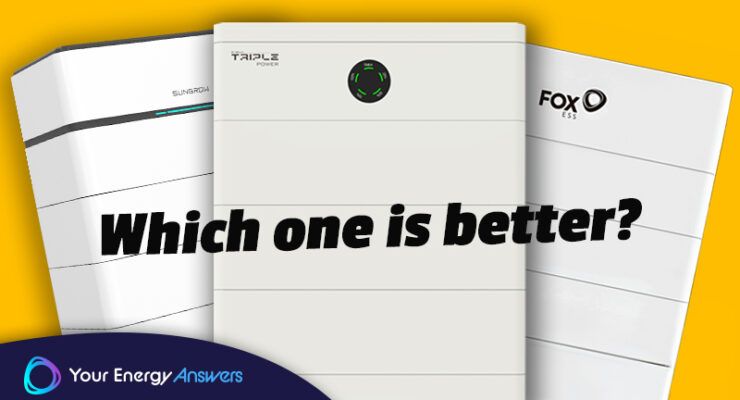
SolaX, Sungrow and Fox ESS are all valid battery options, but they suit different buyers. Sungrow is a safe, well-known choice with strong installer familiarity. Fox ESS may suit homeowners focused mainly on keeping upfront costs down. SolaX stands out as the stronger all-round option, offering better flexibility, smart monitoring, safety features, backup potential and room to grow as your home uses more electricity. For homes adding EV chargers, electric hot water, air conditioning or larger evening loads, SolaX is the more future-ready choice.
When comparing SolaX Battery vs Sungrow and Fox ESS Battery, the easy answer is to look at price. But the smarter answer is to look at the whole system: battery capacity, backup potential, safety features, monitoring, expandability and how well the battery suits the way Australian homes are changing.
More households are adding EV chargers, heat pump hot water, induction cooking, ducted air conditioning, pool pumps and larger evening loads. That means a good battery should not only solve today’s power bill problem. It should also be ready for tomorrow’s energy habits.
That is where SolaX stands out. Sungrow is a strong, proven option. Fox ESS can appeal to homeowners chasing value. But SolaX offers one of the best all-round combinations of scalability, smart energy control, safety features and future-ready design.
Quick Comparison Table: SolaX vs Sungrow vs Fox ESS
| Feature | SolaX Battery | Sungrow Battery | Fox ESS Battery |
|---|---|---|---|
| Best suited to | Homes wanting a flexible, future-ready battery system | Homes wanting a proven, mainstream battery option | Homes focused on lower upfront cost and modular storage |
| Battery type | LFP battery options | LFP battery options | High-voltage battery options, including LFP models |
| Capacity flexibility | Very strong, with SolaX T-BAT range listed at 7.3–47.9 kWh (HS51: 10.2 kWh-66.5 kWh) | Strong, especially with SBH modular expansion | Strong, with several scalable battery ranges |
| Safety features | IP65 (HS51:IP66), soft-start protection, aerosol fire suppression, remote diagnosis on T-BAT range | System-level protection and iSolarCloud monitoring | IP65 protection and modular high-voltage battery options |
| Smart management | SolaX Cloud, remote fault diagnosis, upgrade and maintenance | iSolarCloud monitoring | Fox ESS monitoring and support resources |
| Backup potential | Strong when designed correctly, especially with compatible hybrid systems | Strong when correctly designed | Depends heavily on inverter selection and installer experience |
| Expandability | One of its biggest strengths | Strong | Strong on paper, but brand/support confidence depends on installer |
| Overall impression | Best all-round choice | Safe and familiar choice | Budget-friendly contender |
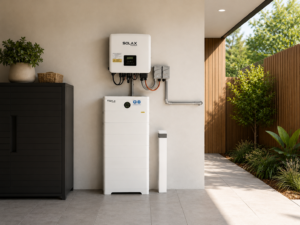
Why SolaX Stands Out
SolaX has become more than just an inverter brand. Its newer battery ecosystem is designed around the way modern homes actually use energy: storing excess solar, powering evening loads, managing appliances and preparing for future electrification.
The SolaX T-BAT-SYS-HV-S3.6 battery range is listed with a 7.3 kWh to 47.9 kWh capacity range, stackable modules, plug-and-play design, maximum 50A charge/discharge current, more than 6,000 cycles, LFP battery cells, IP65 protection, soft-start protection, aerosol fire suppression, and remote fault diagnosis, upgrade and maintenance features.
The SolaX TSYS-HS51 battery range is listed with a 10.2 kWh-66.5 kWh capacity range, stackable modules, plug-and-play design, maximum 70A charge/discharge current, more than 6,000 cycles, Maximum 10% expansion of effective power over the entire life cycle to increase cycle life (optimizer version),LFP battery cells, IP66 protection, soft-start protection, aerosol fire suppression, and remote fault diagnosis, upgrade and maintenance features.
That is a strong feature set because it covers more than just storage size. It addresses flexibility, safety, installation practicality and long-term servicing. For a homeowner, that matters. A battery should not become outdated the moment your household starts using more electricity.
SolaX also offers the X1-IES all-in-one energy storage system, which combines hybrid inverter and battery storage into a more integrated setup. SolaX describes the X1-IES as having 97% efficiency, 6 kW output, IP66 protection, SolaX Cloud smart energy management and modular design supporting up to 20 kWh.
This is where SolaX gets interesting. It is not only selling a battery stack. It is building a broader home energy ecosystem. That makes it a better fit for households thinking beyond simple solar storage.
Where Sungrow Fits In
Sungrow is a well-established name in solar and battery storage. It is widely used, many installers are familiar with it, and it has a strong reputation in the Australian solar industry.
The Sungrow SBH high-voltage LFP battery is modular and stackable, with Sungrow listing 5 kWh per module, up to 8 modules per unit, up to 4 units max, and up to 160 kWh in total capacity. It also lists a 50A maximum current, system-level protection and iSolarCloud monitoring.
So Sungrow is not weak. Far from it. It is a solid, mainstream, dependable battery option.
But compared with SolaX, Sungrow can feel more conventional. It is a very good choice if you want a familiar system with broad installer knowledge. But SolaX has the edge for homeowners who want a more integrated, future-facing battery setup with strong safety features, smart control and practical expandability.
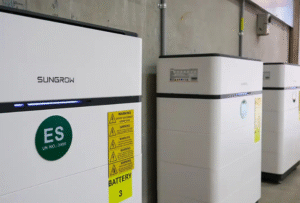
Where Fox ESS Fits In
Fox ESS is often considered by homeowners who want a more cost-conscious battery option. It offers several battery ranges in Australia and has some strong numbers on paper.
The Fox ESS Australian battery page lists the EQ4800 as a high-voltage storage battery with 4.66 kWh capacity, scalability up to 41.93 kWh and IP65 ingress protection. It also lists the EP11 with an energy range of 10.36 kWh to 41.60 kWh, and other ranges such as CQ6 and CQ7 with larger scalable capacities.
Fox ESS can make sense when budget is the main driver. It has modular storage options and can work well in the right installation.
However, the concern is not always the product spec sheet. It is the confidence around system design, local support and long-term serviceability. With Fox ESS, the installer becomes even more important. If the battery is not designed properly around backup loads, inverter compatibility and household usage, the result may not feel as polished as a better-integrated system.
The Real Difference: System Thinking
The biggest reason SolaX comes out ahead is that it feels more like a complete home energy system.
A battery is not just a storage box. It has to work with:
- your solar panels
- your inverter
- your backup circuits
- your monitoring app
- your future EV charger
- your household load profile
- your installer’s design choices
- your long-term energy goals
SolaX appears to understand this better than many brands. The T-BAT system gives strong modular battery flexibility, while the X1-IES points toward a more integrated home energy platform. That is important for homeowners who do not want to keep replacing or redesigning their system every few years.
Sungrow is dependable. Fox ESS can be affordable. But SolaX feels better positioned for households that want a battery system that can grow with them.
Backup Power: Why Design Matters
Backup is one of the most misunderstood parts of buying a battery.
Some homeowners assume that installing any battery means the whole house will keep running during a blackout. That is not always true. Backup depends on the inverter, battery, switchboard design, circuits selected, appliance loads and local electrical rules.
This is another area where SolaX has a strong case. Features such as soft-start protection, remote diagnosis, smart energy management and scalable storage make it easier to build a more capable battery setup when paired with the right system design.
Sungrow can also be excellent for backup when installed properly. Fox ESS can work too, but it is more important to ask detailed questions about what is actually backed up and how the system will perform during an outage.
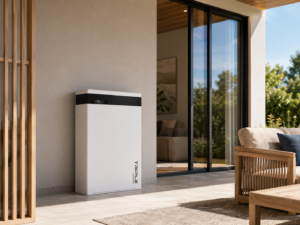
Expandability: Why SolaX Has an Advantage
A lot of homeowners underestimate how much electricity they may use in the future.
Today, you may only want to store solar for evening use. But in a few years, you may have:
- an electric vehicle
- a second EV
- heat pump hot water
- induction cooking
- larger air conditioning loads
- a home office
- a pool pump
- a VPP-compatible battery setup
That is why battery expandability matters.
The SolaX T-BAT range being listed from 7.3 kWh to 47.9 kWh (HS51: 10.2 kWh-66.5 kWh) gives households a wide range of sizing options. The system is also designed with stackable modules and battery expansion support, subject to inverter compatibility.
Sungrow also has strong expandability, especially with the SBH range. Fox ESS also has scalable options. But SolaX combines expandability with a more rounded feature set: safety, smart management, remote maintenance and strong ecosystem integration.
That is why SolaX does not just win on size. It wins on balance.
Which Battery Offers the Best Value?
If you define value as the lowest upfront price, Fox ESS may be competitive.
If you define value as a familiar, proven brand with a large installer base, Sungrow is a strong contender.
But if you define value as the best long-term mix of performance, flexibility, smart control, safety and future readiness, SolaX is the stronger choice.
The cheapest battery can become expensive if it is too small, poorly designed, hard to expand, limited in backup capability or unsupported later. A slightly better-designed battery ecosystem can be worth more over the life of the system.
Final Verdict: SolaX Is the Stronger All-Round Choice
Sungrow is a safe and proven choice. Fox ESS can be a reasonable budget-friendly option. But for most Australian homeowners comparing SolaX Battery vs Sungrow and Fox ESS Battery, SolaX is the standout all-rounder.
It offers strong storage flexibility, smart monitoring, safety-focused features, remote management, scalable battery options and a more complete home energy direction.
So the simplest answer is this:
Choose Fox ESS if price is the main priority.
Choose Sungrow if you want a familiar and widely used battery brand.
Choose SolaX if you want the best balance of performance, safety, expandability, backup potential and long-term value.
For homes moving towards EVs, electric appliances and higher evening electricity use, SolaX is the battery system that feels better prepared for the future.