Australia’s Commercial Solar Expansion: Unlocking the 1MW Market and Navigating Industry Risks
Australia’s commercial energy landscape stands on the edge of a historic transition. The federal government has officially announced a massive overhaul of solar policy that will directly affect businesses, solar installers, and the national electricity network.
This policy change addresses long-standing regulatory bottlenecks, opening up significant financial support for medium to large commercial energy systems across Australia.
The 100-Kilowatt Barrier: Eliminating a Flawed Regulatory Limit
For years, Australia’s federal renewable support framework featured an artificial constraint. Under the Small-scale Renewable Energy Scheme, commercial systems capped at 100 kilowatts received Small-scale Technology Certificates (STCs). These certificates were routinely converted into direct upfront discounts on invoice totals.
System installations exceeding 100 kilowatts were forced into the Large-scale Generation Certificate framework. That administrative model required ongoing certificate creation, complex administrative tracking, and exposure to fluctuating certificate spot markets. Consequently, many Australian companies demanding 150, 250, or 400 kilowatts intentionally limited system capacity to 99.9 kilowatts simply to secure the simpler STC discount.
Historical Context: Businesses across Australia were effectively forced into smaller energy systems that failed to reflect their operational electricity needs or roof space, solely because regulatory policy drew an arbitrary line at 100 kilowatts.
SRES Limit Expanded to 1 Megawatt (1,000 kW)
Minister Chris Bowen confirmed that eligible commercial, industrial, agricultural, and community solar installations up to 1 megawatt will enter the Small-scale Renewable Energy Scheme.
Effective Date: Scheduled for rollout from 1 October 2026.
Upfront Discount: Projected upfront capital cost reductions of approximately 20 to 25 percent.
Projected Upfront Savings Across System Capacities
| System Capacity | Estimated Upfront STC Discount |
| 250 kW | ~$68,000 |
| 500 kW | ~$136,000 |
| 850 kW | ~$232,000 |
In Sydney, an 850-kilowatt commercial solar array can generate roughly 1,450 megawatt-hours of clean power annually, delivering operational electricity savings exceeding $200,000 every year. Actual savings depend on site geography, electricity tariffs, usage patterns, export permissions, and equipment performance.
Bridging Australia’s “Missing Middle”
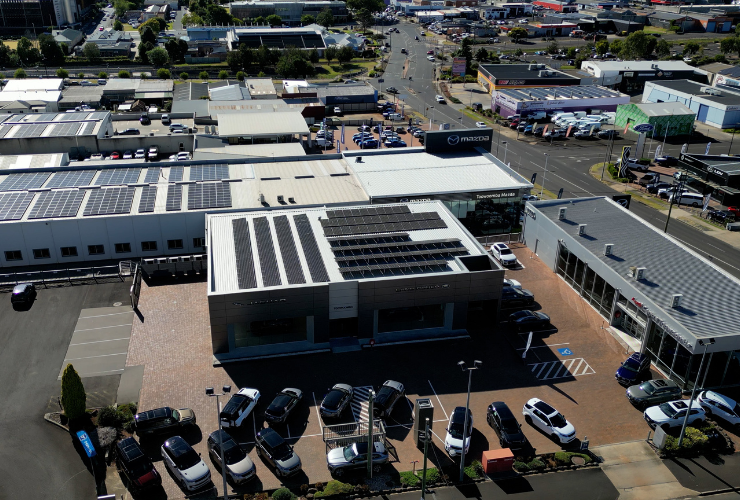
Australia leads the world in residential rooftop solar adoption, with approximately 22 gigawatts installed on homes as of August 2026. Conversely, Australian businesses have deployed only about 5.6 gigawatts, despite holding immense technical potential estimated at over 80 gigawatts.
This structural gap—the “Missing Middle”—includes thousands of key commercial assets:
Production factories and manufacturing plants
Logistics hubs and storage warehouses
Agricultural sites and regional farms
Shopping centres and large retail outlets
Cold storage buildings and distribution facilities
Schools, universities, and community centres
Specialist commercial energy firms, such as Smart Commercial Solar led by Huon Hoogesteger, are positioned to guide companies through this expanded landscape. The primary focus shifts from merely filling roof space to engineering holistic energy platforms that integrate solar generation, battery storage, peak demand management, and EV fleet charging.
Government Strategy: Solving Wholesale Electricity Challenges
The policy expansion aligns with broader national energy requirements. Ageing coal-fired power stations are reaching retirement, yet utility-scale renewable pipelines face emerging headwind challenges.
Wholesale Price Drop: Wholesale electricity prices fell approximately 47 percent year-on-year to around $74 per megawatt-hour in recent quarterly reports, driven by high renewable penetration during daytime hours.
Investor Uncertainty: Lower daytime wholesale prices make funding new large solar utility projects harder, as daytime solar generation competes against itself.
Target Vulnerability: BloombergNEF highlights risks that Australia could miss 2030 renewable targets unless new project deployment accelerates.
Commercial rooftop solar offers a pragmatic solution. Roof space is already developed, avoiding years of planning approvals, land acquisition disputes, and long transmission line construction. Crucially, businesses install rooftop solar to avoid expensive retail electricity tariffs rather than selling power into wholesale markets.
Grid Connections and Export Limits
While policy grants financial rebates for larger systems, local electricity networks control connection conditions.
Network operators in high-penetration areas may enforce static export limits, flexible curtailment, or non-export conditions to preserve grid stability. The Australian Energy Market Operator (AEMO) continues to emphasise careful integration as minimum daytime grid demand reaches record lows. Successful installations must be designed around granular interval consumption data, weekend load profiles, and seasonal variations.
Commercial Battery Integration Reaches Economic Viability
The combination of solar rebates and falling hardware costs is altering commercial battery economics.
Hardware Cost Reductions: Standard commercial battery units (around 200 kilowatt-hours) are entering distribution channels between $60,000 and $80,000 before installation. This puts raw equipment costs near $400 per kilowatt-hour.
Total Installed Target: Including engineering, switchboard upgrades, cabling, fire safety, and grid approvals, installed pricing approaching $600 per kilowatt-hour creates strong payback timelines.
Operational Value:
Self-Consumption: Captures surplus weekend or lunchtime solar power that would otherwise be curtailed or exported at low rates.
Demand Charge Reduction: Discharges during operational spikes to lower peak demand billing charges.
Backup Security: Protects critical operational loads during network outages.
Risk Considerations: Certificate Markets, Quality, and Recycling
While the policy change is positive, three critical operational risks require proactive management:
1. STC Certificate Supply Dynamics
An influx of high-volume commercial certificates could increase market supply. If liable entity surrender percentages are not recalibrated promptly, certificate prices could soften, impacting both commercial and residential upfront discount levels.
2. Industry Workmanship Standards
Large commercial projects demand rigorous structural engineering, electrical protection settings, fire safety compliance, and switchboard capacity verification. Rapid demand growth risks attracting inexperienced operators focused on low-cost, low-quality installations.
3. Solar Panel End-of-Life Infrastructure
In early 2026, the federal government announced a $24.7 million National Solar Panel Recycling Pilot targeting 100 collection sites and 250,000 decommissioned panels. However, procurement processes were suspended mid-2026 due to administrative appeals, leaving the initiative temporarily stalled. Clear product stewardship mandates and urgent procurement resolution are essential to handle older panels replaced during commercial retrofits.
Summary Action Plan for Australian Businesses
Evaluate Interval Energy Data: Analyse half-hourly consumption profiles prior to dimensioning equipment.
Assess Grid Export Host Capacity: Consult early with local network distributors regarding export restrictions.
Model Combined Solar and Battery Storage: Determine financial payback using co-located battery storage to mitigate export curtailment and peak demand charges.
Select Qualified Commercial Specialists: Partner with accredited electrical engineers and experienced installers to ensure safety, durability, and compliance.