
Commercial Solar Case Study: How Upgrading an Aging System Slashes $10k/Month Power Bills in Western Sydney
When running a high-volume commercial venue, electricity costs can rapidly swallow your profit margins. For Candelori’s, an iconic fine-dining establishment in Western Sydney, monthly power bills had escalated to an eye-watering $8,000 to $10,000 per month.
Despite having a 29 kW solar system installed over a decade ago, owner Ross Candelori realised the system was barely covering a quarter of the venue’s daily energy usage.
What went wrong with a system that was once state-of-the-art? More importantly, how can Australian commercial businesses diagnose hidden solar failures and double their rooftop energy generation?
Here is a deep dive into a real-world commercial solar audit, exploring the failure points of older systems, the impact of poor maintenance, and how modern 500W+ solar panels combined with battery storage offer a massive return on investment (ROI).
Executive Summary: Candelori’s Commercial Solar Audit
| Metric | Original System (Installed ~12 Years Ago) | Proposed Upgrade Strategy |
| Rooftop Capacity | 29 kW (90 x 290W LG Panels) | ~50 kW (Modern 500W+ Aiko Panels) |
| Inverters | 2 x Legacy German-made SMA Inverters | 1 x Modern 50 kW Commercial Inverter |
| Battery Storage | None | ~100 kWh Commercial Battery System |
| Mounting Design | Tilted Racks (Lower roof density) | Flat Layout (Maximised roof square footage) |
| Identified Issues | Shattered glass (hotspots), blown fuses, AC shading, loose MC4s | Shading elimination, bird spikes, regular 2–3 yr service |
| Est. Payback Period | Original system paid off in 4.5 years | High ROI via evening battery discharge |
1. What Happens to Commercial Solar Systems After 10+ Years?
Around 2012, Candelori’s installed one of the finest commercial solar arrays money could buy: LG 290W panels paired with SMA inverters. Back then, this combination was the gold standard for premium efficiency and German-engineered reliability.
However, a decade is a lifetime in renewable energy technology:
Manufacturer Shifts: LG has exited the solar panel manufacturing business entirely, and SMA has largely scaled back from Australian residential and light-commercial markets.
Sourcing Replacement Parts: Finding matching legacy replacement parts for a 12-year-old system is virtually impossible, often forcing businesses to choose between patched secondhand fixes or full system overhauls.
Technological Obsolescence: Modern panels produce nearly double the wattage per square meter compared to panels manufactured a decade ago.
Key Takeaway: A 10-year-old commercial solar array isn’t necessarily useless—in fact, Candelori’s original system paid itself off in just 4.5 years. However, as component warranties expire and internal wear accelerates, unmaintained legacy systems become silent financial drains.
2. The Roof Audit: Top 5 Hidden Issues Destroying Solar Yield
During a comprehensive rooftop inspection conducted by expert solar technicians, several critical issues were uncovered that explain why power bills remained sky-high:
A. Thermal Hotspots and Shattered Glass
Inspectors discovered a fully shattered solar panel with scorched backing sheeting.
The Cause: A failure in the panel’s internal solder joint generated an extreme thermal hotspot. The intense localised heat shattered the protective tempered glass and burned through the back sheet.
The Impact: Rain and moisture seep directly into shattered panels, causing severe earth faults. When wet weather hits, the central inverter trips into fault mode to prevent fires, shutting down power generation across entire strings of panels.
B. Severe Shading from Retrofitted HVAC Equipment
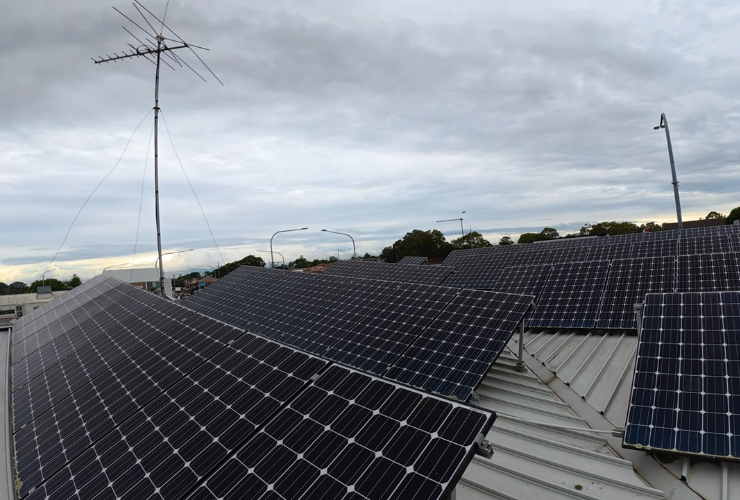
Commercial buildings frequently undergo rooftop upgrades. At Candelori’s, heavy-duty commercial air conditioning units were installed after the solar system.
The Problem: The tall HVAC units cast long shadows across multiple panel rows. Because traditional solar strings operate like Christmas tree lights, shading just two or three panels can severely throttle the output of an entire string.
C. Grease Vent Proximity & Organic Growth
Operating a commercial kitchen means grease and oil vents continuously exhaust onto the roof space.
Grease Accumulation: Placing panels too close to kitchen exhaust vents coats the glass in a sticky film that attracts dirt and ruins efficiency.
Lichen & Moss: While tilted panels self-clean better than flat ones, lichen growth along the bottom edges of aging panels degrades output over time if left uncleaned.
D. Pest Damage and Antenna Perching
Local bird populations favoured a rooftop television aerial positioned directly above the solar array. Years of accumulated bird droppings covered adjacent panels, shading photovoltaic cells and introducing corrosive organic matter.
E. Degrading Cable Ties & Hanging Wires
Cheap plastic cable ties deteriorate under harsh Australian UV rays. Over a decade, broken ties leave high-voltage DC cables dangling directly onto metal roof sheets, creating potential abrasion hazards.
3. Electrical Diagnostics: Why Inverters Fail Quietly
Down at the inverter station, testing revealed a stark reality:
Inverter 1: Producing a negligible 750 Watts (the equivalent of roughly 3 functional panels out of dozens).
Inverter 2: Producing 2.3 kW—a fraction of its rated capacity.
Diagnostic Breakdown:
Loose MC4 Connectors: High-voltage DC connectors were found loose and unclipped, presenting a dangerous electrical arc hazard.
Blown Inverter Fuses: Internal continuity testing revealed two blown string fuses inside the electrical isolators.
Internal Damage: The inverter had sustained internal damage trying to operate against severe electrical ground faults created by the shattered panel on the roof.
4. The Solution: Transforming 29 kW to a 50 kW Powerhouse with Battery Storage
Patching up a 12-year-old system with hard-to-find secondhand parts is rarely cost-effective for a business with an $8,000+ monthly electric bill. The ultimate strategy involves leveraging modern solar density and intelligent storage.
1. Swapping Tilt Mounts for High-Density Flat Layouts
Historically, commercial panels were installed on tilted frames to optimise the sun angle. Modern design strategy prioritises total generation footprint. Laying panels flat allows installers to fit significantly more panel surface area onto the exact same roof footprint without row-to-row shade gaps.
2. Upgrading to 500W+ Modern Panels
By replacing aging 290W LG modules with modern 500W+ N-Type panels (such as Aiko), energy generation nearly doubles on the exact same roof area, pushing system capacity from 29 kW straight to 50 kW.
3. Adding a 100 kWh Commercial Battery System
For restaurants, bars, and evening venues, peak energy consumption happens after sunset when kitchen equipment, lighting, and cooling run at full tilt.
Daytime: The 50 kW solar array powers daytime operations and fills the 100 kWh battery storage system.
Night-time: The restaurant runs off stored solar energy during peak evening trade hours, avoiding expensive peak grid tariffs.
Overnight: Stored power handles baseline loads like walk-in cold rooms and freezers.
5. Essential Commercial Solar Maintenance Checklist
To avoid the costly “set and forget” trap, Australian commercial property owners should schedule a professional solar inspection every 2 to 3 years.
Use this quick checklist during your next facility maintenance review:
Thermal Imaging Audit: Scan panels for dangerous internal hotspots, microcracks, or shattered glass.
Inverter Log Inspection: Check inverter fault logs for recurring earth leakage errors during rain.
Rooftop Clearance Inspection: Verify no newly installed HVAC units, antennas, or ductwork cast shadows on panels.
Grease Vent & Debris Check: Clean panels near kitchen exhausts and scrub away lichen/moss buildup.
Cable Management Check: Ensure all DC cabling remains secured off the roof sheet using stainless steel clips or UV-rated ties.
Connector Integrity: Inspect MC4 connectors and isolator enclosures for moisture ingress or thermal discoloration.
The Big Picture: Supporting Small Business Energy Transition
Rising electricity tariffs continue to pressure Australian small businesses—the backbone of the economy. For commercial operators working seven days a week, modernising an outdated solar system isn’t just an environmental choice; it’s a vital financial strategy to protect operating margins.
By upgrading aging 200W–300W arrays to modern 500W+ solar architectures paired with battery storage, commercial enterprises can take back control of their utility expenses and ensure long-term business resilience.