
How to Buy a Home Battery in 2026
Batteries can still be one of the smartest home energy investments in 2026, even though the rebate has reduced a bit. Solar remains one of the best ways to cut your power bills, and paired with the right battery it gives you something a bill discount never can: independence from a grid — and a market — you don’t control.
The real risk isn’t the technology. It’s buying the wrong system from the wrong company for the wrong reasons. When someone waves a rebate, a discount or a “limited-time offer” in front of you, that pressure is doing a job — and it isn’t working for you. Slow down. These twelve tips are the questions a good installer will happily answer, and the ones a cowboy would rather you never ask.
Know why you want solar or a battery
Before brands, prices, rebates or finance offers, answer one simple question: why do you actually want this? To lower your power bills? To shield yourself from rising prices? For backup during blackouts? Because you’re buying an EV and want to charge it from the sun? Or simply for more energy independence?
All of those reasons are valid — but they don’t lead to the same system design. A young family that gets home at 6pm and switches everything on needs something different from a retired couple who use most of their power during the day. Start with the mission. Is your North Star saving money, backup, independence, future-proofing or driving an EV?
Use your real energy data
Don’t buy solar or a battery based on guessing. Your energy data is the DNA of your house. A proper installer should look at your electricity bills, your smart meter and interval data if it’s available, and your solar monitoring app if you already have one. Your data tells the truth that a sales pitch can hide. Before you buy, ask the installer to explain what your usage profile actually shows.
Understand your nighttime usage
A battery earns most of its keep after the sun goes down. During the day your panels are producing power; it’s in the evening — when the oven goes on, the air conditioner starts humming, the TV’s running, devices are charging and the kids are showering — that you hit peak demand. That’s when the battery does the heavy lifting.
So ask yourself how much power you actually use from sunset to sunrise. If you only use around 5–6 kWh overnight, you probably don’t need a 30 kWh battery just because someone made it sound impressive. But if you’ve got a large home, electric heating, ducted air conditioning, a pool, maybe electric hot water and a family that comes alive after six, your nighttime usage may be much higher than you think — and a bigger battery may make sense.
The goal isn’t the biggest battery. It’s the battery that works hardest — one that charges and discharges properly, and is correctly sized, every single day.

Make sure your solar system is big enough
This is one of the biggest mistakes people make. A battery doesn’t create energy — it only stores it. In summer, almost any system looks good: the days are long, the sun is strong and the battery fills easily. Winter is the real test.
If your solar is too small, shaded or underperforming, you may not have enough excess to charge the battery properly — which means you’ve paid for storage capacity you’re not fully using. In many cases the smarter move is to upgrade your solar first: add a second array on the same roof, or replace an old, tired system completely, before you invest in storage.
Understand kWh versus kW
This sounds technical, but it’s simple — and it’s where a lot of buyers get caught.
| Kilowatt-hours (kWh) | Kilowatts (kW) |
|---|---|
| How much energy the battery stores. Think of it as the size of the fuel tank. | How much power it can deliver at once. Think of it as the size of the pipe out of that tank. |
You can have a massive 40 kWh battery, but if it can only deliver 3 kW at a time, it may still struggle when your home suddenly needs a lot of power. So don’t only ask “how big is the battery?” Ask “how much power can it deliver continuously, and what can it actually run in my home?” Capacity and power are not the same thing.
Don’t get rebate-obsessed
Rebates are helpful — no question. But don’t let the rebate become the reason you buy the wrong system. The dangerous logic goes: bigger battery, bigger rebate, bigger benefit. And for some operators it’s simpler still — bigger battery, bigger profit. A rebate should improve a good decision, not create a bad one.
The real question isn’t how much you save up front. It’s what the total outcome looks like over the next ten years.
A cheap system that fails early isn’t cheap. It’s an expensive problem with a discount sticker on it.
Check the brand and the local support
A home battery is not a toaster. It’s a serious electrical product with software monitoring, firmware updates, warranty requirements, grid rules and long-term support needs. And Australia is tough on electronics — we have heat, humidity, storms, salt air along the coast, and a grid that can be, let’s say, full of personality.
If the brand has no real local support, you can end up with an orphan system: the installer blames the manufacturer, the manufacturer blames the installer, and you’re left standing in front of a dead box on the wall wondering why the app hasn’t updated since 2022. Price matters, of course — but support matters just as much, maybe a bit more.
Read the warranty properly
A ten-year warranty sounds comforting, but not all ten-year warranties are equal. You need the details: what’s actually covered? Does it include labour? Who pays if the battery has to be removed, shipped, replaced or recommissioned? Some warranties look fantastic on the front page and become a lot less exciting once you read the fine print.
Most normal people don’t want to sit down with a cup of tea and read battery warranty documents for fun — fair enough. But your installer should be able to explain the warranty clearly. If all they offer is “it’s a ten-year warranty, mate, it’s really good,” slow down. The warranty isn’t a slogan; it’s your protection when something goes wrong.
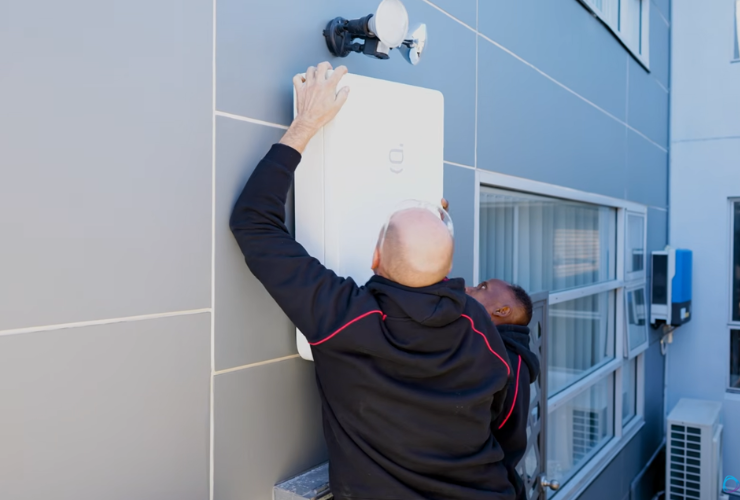
Ask exactly what’s backed up
This is one of the biggest traps in the whole battery conversation. Many people assume that if they buy a battery, the entire house keeps running during a blackout. That’s not always true. Some batteries provide no backup at all. Some back up only selected circuits and others can run the whole home, but only within certain power limits and some need extra hardware like a gateway or a transfer switch — and usually, the more complete the backup, the higher the cost.
So ask clearly what stays on when the grid goes down. Whole-home backup sounds great, but it can drain the battery very quickly. For many homes, essential-circuit backup is the sensible option — it keeps the important things running without pretending your house is a luxury resort during a storm.
Whatever you choose, get it written into the quote. Don’t discover your backup limits during your first real blackout — that’s a very dark way to learn the lesson.
Can solar recharge the battery during a daytime blackout?
It sounds obvious, but not every system can do this. Some give you one tank of stored energy, and once that’s gone they can’t refill it from the sun until the grid comes back. There’s a big difference between a battery that gives you a few hours of backup and a system that keeps using solar during the day to recharge and extend your backup.
Ask your installer in plain English: “Can this battery charge from my solar panels during a blackout?” Then ask: “What happens if the battery goes flat overnight — does the system restart from solar the next morning?” That feature is often called black start capability.
Make the installer test the system before leaving
A battery installation isn’t finished just because the box is on the wall and the app looks pretty. Before the installer leaves, the system should be properly tested: does excess solar charge the battery? Does the battery discharge when the home needs power? Does the app show the correct information? Do the backup circuits work when you simulate a blackout by switching the supply off?
A good installer won’t be offended by this — they’ll expect it. A cowboy just wants the app working, a photo taken, the money collected, and to be gone. Proper commissioning isn’t part of the install; it’s the proof that the system actually works.
Choose quality, expandable tech — and a local installer
The battery is the hardware, but the installer is the lifeblood of the system. You want a proper local installer: someone with a reputation to protect, who knows your area, your weather, your network rules and the homes in your region — someone who’s been around longer than five minutes and plans to be here for the next ten years. Australia already has hundreds of thousands of orphaned solar systems where the company that sold or installed them is long gone. Learn from that.
The battery rebate may only be available once, so size the system properly today. But as prices fall and modular designs improve, it can be valuable to add more modules later. The lesson is simple: buy the right size now, choose technology that gives you room to grow, and choose an installer who’ll still be there when you want to grow.
The final word
At the end of the day, we’re not really talking about panels, lithium, copper, apps and kilowatt-hours. We’re talking about your home — and about getting off the treadmill of rising energy prices as much as possible.
Solar and batteries can be fantastic. But the right outcome comes from good design, proper sizing, quality equipment, honest advice and strong after-sales support. A good system can genuinely change the way your home uses power. A bad one can give you years of headaches and a lot of wasted money. So our advice is simple: go quality, go local.